Hotel lighting suppliers can offer similar fixture families while differing in optical data, controls, finish options, manufacturing capability, documentation, schedule, and service support. Buyers can compare them more reliably by issuing a shared fixture schedule, checking exact model evidence, reviewing representative samples, and recording the scope and assumptions behind each quotation. The right supplier is the one whose documented offer fits the project requirements and can be delivered under a workable approval and change process.
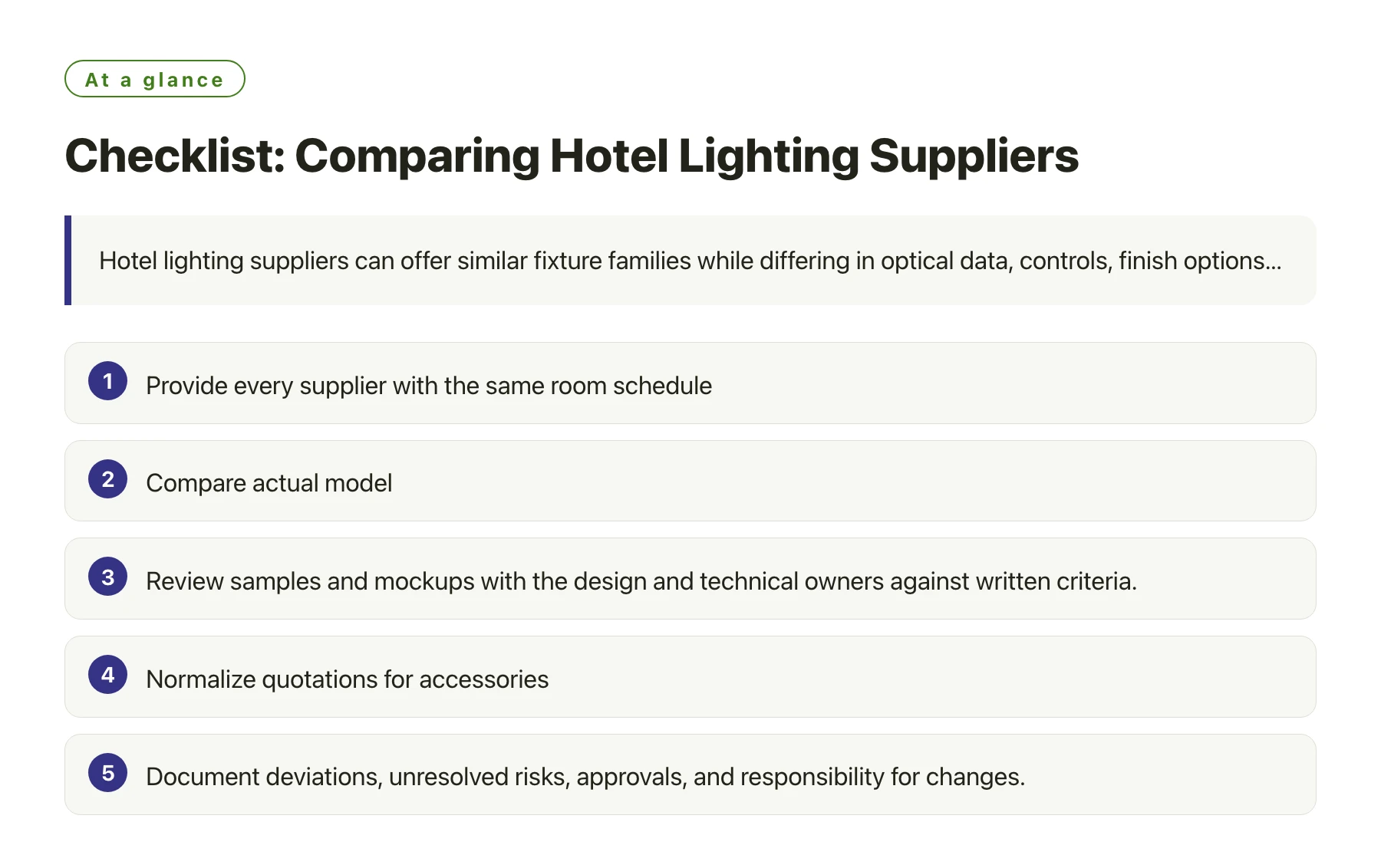
Key takeawaysProvide every supplier with the same room schedule, fixture tags, quantities, and performance brief. · Compare actual model, optics, driver, controls, finish, documentation, and production site. · Review samples and mockups with the design and technical owners against written criteria. · Normalize quotations for accessories, lead time, packaging, spares, and delivery assumptions. · Document deviations, unresolved risks, approvals, and responsibility for changes.
A comparison sheet should expose where suppliers differ and what evidence is still needed to make a decision.
Prepare one comparable request
List project zones, fixture tags, quantities, mounting conditions, finishes, controls, destination, and delivery sequence. Attach the same current drawings and performance brief for all suppliers. Mark which requirements are mandatory, which preferences can be proposed as alternates, and which design decisions are still open. This lets each bidder respond to one baseline without hiding uncertainty.
Set a response format for model, manufacturer, producing site, optics, output, source, driver, dimming method, finish, accessories, test or compliance documents, packaging, lead time, price, exclusions, and validity. Require suppliers to mark deviations explicitly and attach supporting files. A clean catalogue page is not a substitute for a schedule that identifies the exact configuration offered.
Buyers coordinating JS Sourcing or another supplier should retain a copy of the shared request and each response revision. Keep clarifications in a log and issue material changes to all affected bidders so the comparison remains fair.
Assess capability and production fit
Confirm who manufactures the fixtures and where critical processes take place. Ask which parts are made in-house and which are sourced or subcontracted, including drivers, LED modules, optics, decorative glass, metalwork, finish, and assembly. The answer helps identify dependencies and who must approve a component or factory change. A sales office or broad product catalogue alone does not show how the offered item will be made.
Ask suppliers to explain how they control product revisions, incoming components, assembly, finish consistency, electrical checks, packing, and nonconforming items. Request examples of relevant records or process descriptions where they can be shared. Focus on the exact product features that affect the project rather than scoring generic claims such as “high quality” or “large capacity.”
Discuss the requested quantity and delivery window in terms of the specified model and options. Ask which components have longer lead times, when production capacity can be reserved, and what dependencies may delay the order. Clarify how capacity is allocated if several hotel phases or projects overlap. Record whether the offered schedule depends on rapid sample approvals or final room counts.
Compare technical evidence by model
Check that drawings, photometric data, electrical details, controls information, finish samples, and any required compliance records identify the exact model and revision. If a document describes a product family, ask which variant it covers. Confirm that proposed optics, driver, LED package, trim, and accessories match the quotation. A minor component difference can affect light distribution, dimming, installation, or the validity of supporting evidence.
The Illuminating Engineering Society’s standards collection includes ANSI/IES LM-63, a file format for transferring photometric data. Request the applicable file for each exact luminaire configuration and ask the project lighting designer to confirm its suitability for calculations. A file’s presence does not establish that its model, optics, or version matches the supplier’s current offer. [1]
Route code, electrical safety, emergency lighting, environmental rating, or other market requirements to the project’s qualified technical and compliance owners. Do not treat documents for a related product or another destination as universal approval. Ask suppliers to list which records are available, which remain pending, and the date they can provide them.
Review samples and mockup performance
Use a common review sheet for physical samples. Record supplier, model, finish, optics, driver, accessories, date, and whether the unit is representative of production. Inspect construction, dimensions, finish, joins, hardware, labels, wiring access, mounting components, and serviceability. Photograph important details and note where the sample differs from the final offer.
Assess lighting in a representative room or mockup when the environment could change the decision. Compare the planned scenes, viewpoints, adjacent surfaces, glare, reflections, brightness balance, and controls. A bench sample cannot reproduce room scale or all viewing conditions. Record the settings, surfaces, and layout so the team can compare suppliers consistently.
Separate design, electrical, installation, and commercial approvals. State whether acceptance covers appearance, function, finish, photometric performance, or all specified attributes. If a sample is accepted subject to a revised driver, label, or mounting detail, list that condition and confirm it is closed before production.
Compare controls and integration
List the proposed driver, dimming interface, control protocol, sensor options, and any connection to guest-room or building systems. Confirm the control specialist has reviewed compatibility and commissioning requirements. Ask what components are included and which are provided by the contractor. A supplier’s statement that a fixture is “dimmable” does not specify the compatible system or expected behavior.
Where practical, test the actual fixture and control combination for start-up, scene response, dimming transitions, low-end behavior, and recovery after power interruption. Record the tested configuration and settings. If a mockup uses a temporary controller, identify how it differs from the final system so reviewers do not assume an untested integration has been approved.
Ask suppliers to provide wiring diagrams, terminal information, driver replacement instructions, and any required commissioning steps. These details affect installation time and future maintenance. Compare not only whether a product can be installed, but how easily the hotel team can access and service it after rooms are occupied.
Normalize price, lead time, and exclusions
Compare unit price for the same model, quantity, finish, controls, accessories, packaging, inspection scope, and delivery point. Separate tooling, sample charges, custom engineering, spares, freight, taxes, and other fees. Ask suppliers to price alternates on separate lines and identify the performance or visual changes that accompany each option.
Check production and delivery dates by phase. Include sample and mockup approval, material procurement, manufacturing, inspection, packing, transport, customs, receiving, and installation windows. Ask which milestones depend on the buyer, and what happens if room schedules or quantities change. An estimated factory lead time without these dependencies is not a complete project delivery plan.
Clarify payment timing, quotation validity, minimum quantities, warranty terms, and replacement-part availability. Record assumptions on currency, exchange rates, carton count, delivery access, and phased releases. A simple comparison table should make it clear whether a lower quotation transfers work, risk, or cost to the hotel owner or contractor.
Evaluate delivery and after-sales support
Ask how fixtures will be packed, labeled by room or phase, and protected against handling damage. Confirm whether cartons can be identified at site receiving and whether the supplier can provide packing lists matched to room schedules. If deliveries are split, identify the process for preserving model and finish consistency across production lots.
Review how the supplier handles shortages, transit damage, defects, missing accessories, and delayed replacement parts. Name the contact and response route for each issue. Ask which parts are stocked or made to order, how part numbers are maintained, and what product information the facilities team receives at handover.
Clarify warranty scope and the evidence required to process a claim. Confirm whether installation, commissioning, or use conditions affect coverage. Keep warranty terms with the technical submittal and purchase record; avoid relying on broad promotional statements that do not identify the covered model or process.
Use a decision matrix and close gaps
Score only requirements that the project can compare consistently. A matrix may cover design fit, technical evidence, sample result, control integration, production capability, delivery plan, commercial terms, and support. Define what each score means and name the reviewer. Keep mandatory requirements as pass, fail, or unresolved rather than averaging them into a total.
List open questions by supplier with owner, due date, evidence needed, and decision impact. If a supplier proposes a deviation, show the affected room or fixture tags and route it to the designer or engineer. The buyer should understand the consequences before accepting a substitution, especially when it affects mockups, controls, or maintenance records.
After selection, freeze the approved schedule, documents, sample references, and change process in the purchase package. Track production against those versions and review deviations before dispatch. Following installation, record performance, defects, commissioning issues, and service response so future hotel phases can benefit from actual project evidence.
Sources
Frequently asked questions
What is the best way to compare hotel lighting suppliers?
Issue one fixture schedule and brief, then compare exact model evidence, samples, controls, capability, delivery assumptions, price, and service using the same criteria.
Is an IES file enough to approve a luminaire?
No. It supports photometric review when it matches the exact configuration, but other design, electrical, compliance, installation, and sample checks may still apply.
Should a supplier’s alternate be considered?
Yes, if it is clearly marked and supported by comparable technical and visual evidence. The project’s authorized designer or engineer should approve its effect.
What should be documented after supplier selection?
Keep the approved model schedule, technical files, samples, price and delivery assumptions, open-item closure, change rules, and named release responsibilities.