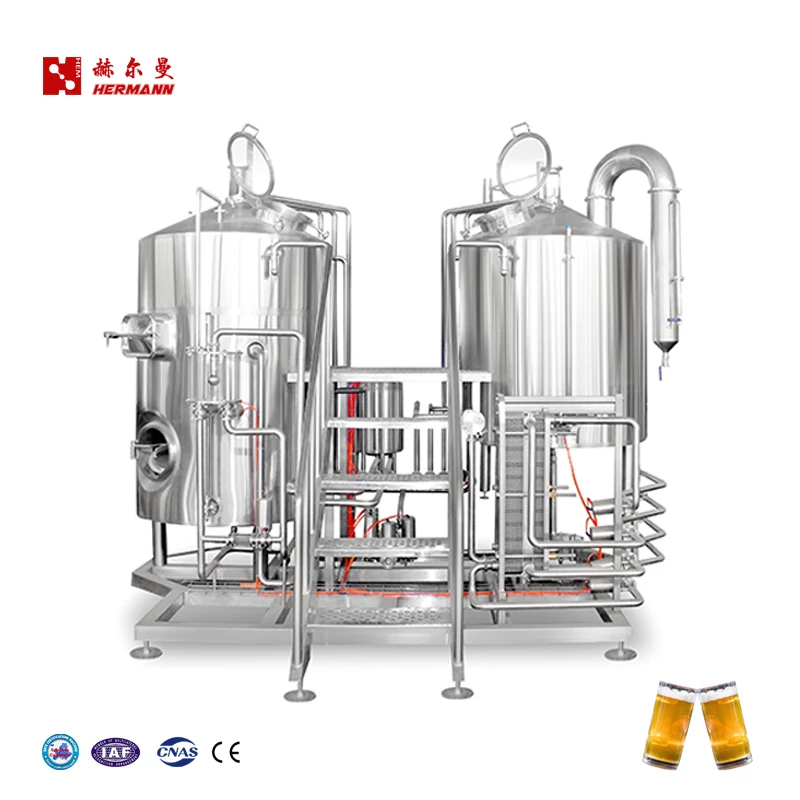
A modern brewhouse should be sized around production flow rather than tank volume alone. A 20 hL system running four turns can produce about 80 hL before cellar losses, but a 15-minute delay per turn adds 60 minutes to the brewing day. Heating rate, lauter area, pump flow, wort cooling, CIP time, and fermentation capacity all affect usable output. Many breweries target brewhouse extract efficiency around 75–90%, while kettle evaporation often falls near 4–10% per hour depending on vessel geometry and process settings. The best design keeps each stage close enough in duration that vessels spend less time waiting.
Brewhouse planning starts with the number of batches expected during a normal production day. A brewery making two 20 hL turns has very different equipment needs from one pushing the same brewhouse through four or five turns. At four turns, a 20 hL system handles roughly 80 hL of wort before transfer and fermentation losses, so a 10% reduction in usable output equals about 8 hL per day.
That production target then sets the pace for every vessel. If mash conversion takes 60 minutes, lautering 90 minutes, boiling 60 minutes, and whirlpool separation plus transfer 45 minutes, the lauter stage already occupies more time than the kettle stage. Adding a larger kettle will not shorten a 90-minute runoff, so vessel sizing has to follow the sequence rather than the largest capacity number on a quotation.
A brewhouse rated at 20 hL only describes batch size. Daily output depends on how many complete turns the system can finish without long waits between mash, lauter, boil, whirlpool, cooling, and cleaning.
Vessel arrangement changes how much overlap is possible. A two-vessel brewhouse may combine mash and lautering in one vessel and boiling and whirlpooling in another. It uses less floor area and fewer valves, but one vessel cannot perform two operations at the same time. A four-vessel layout separates mash, lauter, kettle, and whirlpool functions, allowing the next batch to move forward while the previous batch finishes another stage.
The benefit becomes easier to see at three or four turns per day. If a combined kettle-whirlpool needs 60 minutes for boiling, 20 minutes for whirlpool formation, 20 minutes for settling, and 30 minutes for transfer, the vessel remains occupied for about 130 minutes. Separating kettle and whirlpool functions can free the kettle earlier, although actual improvement depends on piping, pumps, cleaning, and recipe timing.
Lauter-tun design deserves similar attention because runoff time often changes with grain depth and grist composition. A larger grain bill increases bed depth if vessel diameter stays unchanged, and deeper beds create more resistance to wort flow. High-wheat or high-protein grists may also run slower than a standard pale-malt recipe, so suppliers should receive real recipes rather than a single nominal batch size.
Brewhouse efficiency gives another useful design check. Small and midsize breweries commonly work within roughly 75–90% brewhouse efficiency, although recipe, crush, mash profile, runoff, equipment geometry, and measurement method can move the number outside that range. At 80% efficiency, obtaining the same extract as a 70% process requires materially less malt over hundreds of batches.
Heating capacity has to match the production schedule as closely as vessel volume does. Raising 2,000 liters of wort by 20°C requires far more energy than maintaining a steady boil, and the installed system must deliver that heat within the available batch window. A specification showing only heater kilowatts or boiler horsepower is incomplete unless it also states liquid volume, starting temperature, heating surface, and expected heat-up time.
Steam remains common in commercial brewhouses because jacketed vessels provide broad heat-transfer area and controlled heating. Electric systems can work well at smaller and medium scales, but available electrical service can become a practical limit. If heating takes 20 minutes longer than planned on four daily turns, production loses about 80 minutes before cleaning or cellar work is counted.
Kettle evaporation should also be designed around a measured target rather than maximum steam input. Many breweries operate in a range near 4–10% evaporation per hour, depending on kettle geometry, boil intensity, wort composition, pressure, and process goals. Excess evaporation uses more heating energy and requires more water to reach the intended post-boil volume.
The same measurement approach should extend to pumps and piping. A pump capable of 100 liters per minute does not guarantee 100 liters per minute through a real installation because pipe diameter, elbows, elevation, valves, heat exchangers, and pressure losses alter the operating point. A line that transfers 20 hL in 20 minutes at 100 L/min may take 30 minutes if the installed system delivers only about 67 L/min.
| Design area | Useful planning number | What it affects |
|---|---|---|
| Brewhouse efficiency | 75–90% typical working range | Malt use and extract recovery |
| Kettle evaporation | About 4–10%/hour | Energy use and post-boil volume |
| Four 20 hL turns | About 80 hL/day before losses | Cellar and utility demand |
| 15 min delay × 4 turns | 60 min/day | Labor and daily production time |
Pipe diameter should therefore be selected from required flow, allowable velocity, product characteristics, cleaning needs, and pressure drop. Oversized piping is not automatically better because larger lines hold more liquid and require more water and chemical during CIP. A 25% increase in internal pipe diameter produces a much larger increase in cross-sectional area, so apparently small diameter changes can noticeably alter volume and flow behavior.
Those transfer calculations lead directly into wort cooling. A plate heat exchanger must cool the full batch at the planned transfer rate while incoming water or glycol temperatures remain within design limits. Cooling 20 hL in 30 minutes requires an average wort flow near 67 L/min; cooling the same batch in 45 minutes lowers average flow to about 44 L/min but keeps the whirlpool occupied 15 minutes longer.
Water temperature matters because a heat exchanger cannot be judged from plate count alone. Incoming groundwater may vary by season, and a system that performs well with 10°C water can behave differently when incoming water is considerably warmer. Designers should specify inlet wort temperature, target outlet temperature, coolant temperature, and required flow before selecting exchanger area.
Hot-water recovery can reduce utility demand when production scheduling supports reuse. Water leaving the heat exchanger may be collected in the hot liquor tank for the next mash, sparge, or cleaning cycle. If 2,000 liters of cooling water are recovered at a useful temperature on four turns, the brewery may redirect about 8,000 liters during that production day instead of immediately sending the full volume to drain.
Water recovery only helps when storage capacity and timing match consumption, which brings tank sizing back into the same production model. A hot liquor tank sized for one batch may become too small when two brewing operations need hot water close together. Adding 20–30% operating margin can be more useful than matching the tank exactly to one theoretical water requirement.
CIP belongs in the same schedule because cleaning occupies tanks, piping, pumps, and labor. A 30-minute rinse and cleaning sequence performed three times consumes 90 minutes of equipment availability. Spray coverage, return flow, chemical concentration, temperature, drainability, and valve layout influence whether those minutes produce repeatable cleaning or repeated manual work.
Equipment that cannot be cleaned efficiently cannot maintain its planned production rate. Dead-end piping, poorly drained low points, awkward hose routing, and inaccessible fittings can lengthen cleaning without changing nominal brewhouse capacity. Hygienic design should be reviewed on the process and instrumentation diagram before fabrication, when moving a valve or return line is still relatively simple.
Automation should then be chosen around repeatability and labor. Temperature control, water dosing, pump speed, valve position, vessel level, and timed recipe steps are suitable for automatic control because the same operations repeat across hundreds of batches. A brewery producing 500 batches per year will repeat a 2-minute manual task for more than 16 labor hours annually.
Automation still needs manual control for unusual recipes, sensor faults, slow runoff, or maintenance. Operators should be able to see valve state, pump status, temperature, level, alarm history, and active process step without opening multiple screens. Systems purchased in 2026 also deserve attention to spare PLC components, software access, backups, and local technical support because breweries often keep stainless process equipment for many years.
Instrumentation should focus on measurements that operators can use. Temperature sensors belong where the liquid is properly mixed, flow meters need installation conditions suited to their technology, and level instruments must cope with foam and condensation. Differential pressure across a grain bed can also help brewers observe changes in lautering rather than relying only on pump speed.
Physical layout affects the same daily numbers. If an operator walks an additional 40 meters during each of 20 routine checks, that becomes 800 meters during one brewing day. Hose connections, grain additions, sample points, spent-grain removal, chemical handling, control panels, stairs, and maintenance access should be placed around actual operating movements rather than simply fitting vessels into the smallest floor plan.
Floor drainage needs equal attention because brewing releases large amounts of water during rinsing and cleaning. Slopes, trench drains, hose reach, curb placement, and equipment feet should be reviewed before tanks arrive. Retrofitting drainage after installation usually involves more disruption than adjusting a vessel position during the 2026 design phase.
Utilities also need to be calculated from simultaneous use rather than daily averages. A brewery may heat a kettle while running CIP, cooling fermenters, producing compressed air, and feeding packaging equipment. Electrical service, steam generation, glycol capacity, water pressure, compressed air, CO₂ distribution, and drainage should be checked against overlapping demand.
The cellar places another limit on brewhouse output. Producing 80 hL per day is not useful if only 40 hL of fermentation space becomes available. Ten 40 hL fermenters provide 400 hL of gross vessel capacity, but usable scheduling depends on fermentation time, conditioning time, cleaning, tank geometry, and whether some beers remain in tank for 14, 21, or more days.
Expansion planning should therefore include utilities and physical connections from the start. Leaving space for two additional fermenters, an extra whirlpool, or a larger chiller may cost little during layout work. Increasing electrical service, glycol headers, or process piping after production reaches several thousand hectoliters per year can involve more downtime and construction.
Supplier comparison should use the same operating assumptions for every quotation. Vessel working volume, gross volume, heating area, motor rating, pump curve, surface finish, insulation, valve type, instrument brand, electrical standard, control platform, piping scope, installation support, and commissioning should all be compared on the same basis.
For craft beer equipment purchases, the most useful quotation is one that connects each component to a stated batch volume, recipe range, turns per day, heat-up time, transfer rate, and cleaning method. A price difference of 10–15% can be small compared with several years of additional labor, energy use, slow transfers, or limited production capacity.
Before fabrication, brewers should test the proposed schedule on paper from mash-in through fermenter filling. If four planned turns require 14 hours while the staffing plan allows only 12 hours, the layout or process needs revision before equipment is ordered. Changing vessel use, heating rate, transfer time, or cleaning sequence at the design stage costs far less than rebuilding an operating brewhouse.