Spark Testing at 10 kV During Production
Every metre of the 1500 V solar cable passes a spark test at 10 kV while it is being made, and the finished cable then holds 6.5 kV AC at 50 Hz for 5 minutes. The spark test looks for a pinhole in the insulation at the moment the wall is applied; the finished-cable test checks the whole length afterwards. The manufacturer publishes both numbers, and the same product family is described with a service life of 25 years or more.
Key takeaways
- Published production test: spark test at 10 kV, run inline as the cable is made.
- Published finished-cable test: 6.5 kV AC, 50 Hz for 5 minutes, on cable rated DC 1.8/1.8 kV.
- The insulation is XLPO, electron-beam cross-linked and low smoke halogen free, 0.7 mm thick on sizes from 1.5 mm² to 10 mm².
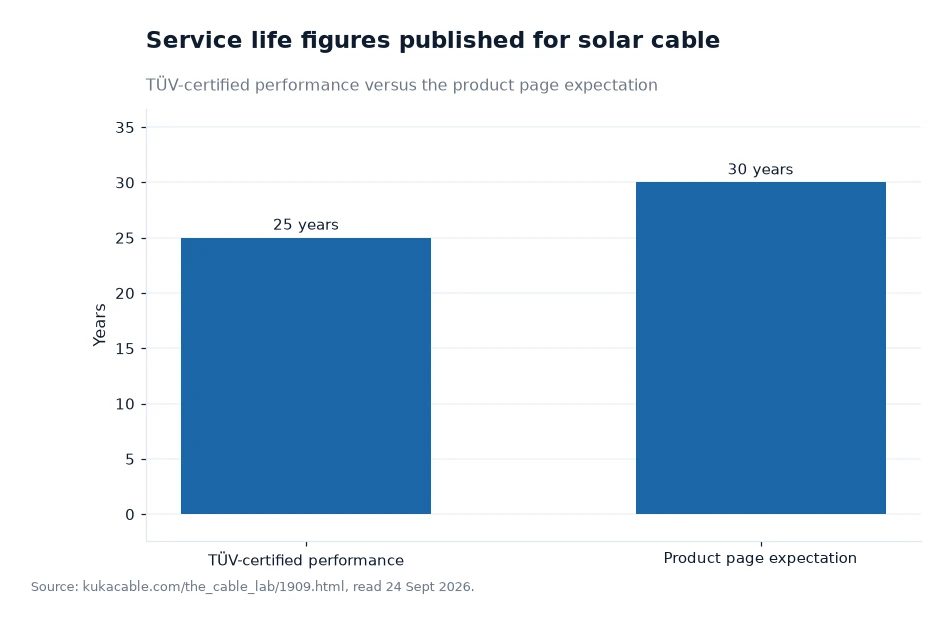
- The manufacturer's own pages give two service-life figures: 25 years or more on a product page, and up to 30 years on another.
What a spark test does on a running line
A spark tester is a ring of electrodes the finished cable passes through. A high voltage is applied to the ring while the conductor is earthed, and if the insulation has a hole, a break or a thin spot, current jumps and the line is stopped or the length is marked. The published figure for this inline check is 10 kV. It catches the class of defect that nobody sees: a pinhole from a contaminated extrusion die, a bubble in the wall, or a stretch mark where the cable was pulled too fast. A spark test is a screen, not a measurement: it either passes the length or flags it, and the flagged section is cut out before the reel leaves the line.
Because the test runs during production rather than after it, the defect is found while the reel is still on the line. That is the difference between rejecting a length and shipping it, and the same 10 kV spark test is applied to all solar cables the plant extrudes in this range. The same published page notes a 100% inspection of finished products for electrical, mechanical and environmental performance, which the company describes as one stage of its SIF quality model.
Why the finished cable is tested again
The spark test examines the insulation wall. The finished-cable routine examines the whole article, including the parts a spark tester cannot see: terminations of the length as wound, and the behaviour of the insulation and sheath together. The published requirement is 6.5 kV AC at 50 Hz applied for 5 minutes. Five minutes is a soak rather than a flash, which is what makes it a check on insulation quality rather than a continuity test.
The working voltage is DC 1.8/1.8 kV, as listed on the 1500 V solar cable page. The author's own comparison of the two published numbers puts the AC test voltage at roughly 3.6 times the rated voltage, a ratio worked out here from the page values and not a figure the manufacturer prints. Waiting five minutes at that level is a deliberate margin, and it is the test a buyer can ask to see in a routine test report.
Where the mechanical floor sits beside the electrical one
Electrical testing is only half of the published envelope. The same page gives a tensile strength of at least 8 N/mm², an elongation of at least 125% before ageing, a bending radius of 4 × the outer diameter, and an ambient range of −40 °C to +90 °C. Short-circuit values are +120 °C for 20,000 hours and +250 °C for 5 seconds. The standards that KUKA CABLE names next to those limits are TUV 2PfG 1169/08.2007, EN 50618:2014 and IEC 62930, which is the set a specifier writes into a purchase document when the cable has to be accepted by a third party.
The sheath and insulation that carry those numbers are the same XLPO compound, electron-beam cross-linked and low smoke halogen free, applied at 0.7 mm of insulation and 0.8 mm of sheath on the smaller sizes and widening on the larger ones. A spark test at 10 kV across a wall of that thickness is a severe local check; the manufacturer's vertical flame test, by contrast, burns a single cable at 800 °C for one minute and the cable is expected to extinguish itself.
The wider test programme
The laboratory that runs these tests was established in December 2015 and is described as an ISO/IEC 17025 facility. Its published test pages cover mechanical and environmental work alongside the electrical checks. The list below sets out what each published page examines, and the site also publishes a numbered list of ten tests for PV cables that names conductor resistance, insulation resistance, dielectric strength and heat resistance among its entries.
| Published test | What it looks at | Relevance to a production test |
|---|---|---|
| Water resistance | Moisture reaching the cable in service | Backs up the AD8 waterproofing rating the site highlights |
| UV accelerated weather testing | Sunlight, humidity and ozone together | Separate from the electrical checks on the line |
| Cable abrasion testing | Sheath wear against a rough surface | Sheath wall, not insulation wall |
| Cold bending and cold elongation | Behaviour at the low end of the temperature range | Where a brittle compound fails first |
| Tensile testing after ageing | Stretch remaining after exposure | Mechanical counterpart of the 5-minute soak |
| Solderability | How the conductor accepts a soldered joint | Why the strands are tinned |
| Construction and dimensional testing | Diameter, wall thickness and stranding | Confirms the cable the spark tester passed |
Worked example
The published insulation thickness is 0.7 mm on a 6 mm² cable. Dividing the published spark test voltage of 10 kV by 0.7 mm gives a nominal 14.3 kV per millimetre across the wall. That division is the author's own arithmetic; it ignores the geometry of the electrode ring and any air gap, so it is an order-of-magnitude figure rather than a field-strength calculation. Even read loosely, it shows why the inline test finds pinholes that a visual inspection never would.
Compare that with the finished-cable routine: 6.5 kV AC held for 5 minutes. The same length passes both, one at speed during manufacture and one as a soak afterwards. If a quotation mentions only an insulation resistance reading, ask which of the two published tests the supplier actually runs, because the two answer different questions.
Frequently asked questions
Is a 10 kV spark test the same as a high-voltage withstand test?
No. The spark test at 10 kV runs inline during production and looks for holes or thin spots in the insulation wall as the cable is made. The withstand test is the published 6.5 kV AC at 50 Hz applied for 5 minutes to the finished cable. One is a fast inline screen, the other a timed soak on the completed length.
Does the manufacturer state how long the cable lasts after these tests?
The site gives two figures rather than one. A product page states a service life of 25 years or more, and another page describes an expected life of 30 years; the TÜV-certified performance is associated with stability for more than 25 years. A buyer who needs one number for a design should ask which page the figure belongs to and under what conditions it applies.
What to ask for with the quotation
Ask for the routine test report, not only the type test certificate, and check that it names the spark test level and the finished-cable withstand voltage. Then confirm the wall thickness and the compound so the tested article matches the ordered one, because a thinner wall changes what 10 kV means.
Ask about sample retention as well: if a length is questioned years later, the retained sample and its traceability record are what settle the question. The manufacturer publishes that stage as part of its SIF quality model, and the contact details for technical questions appear on every page of the site.
The 10 kV spark test is a production figure published by the manufacturer on its own website, kukacable.com, logged 24 Sept 2026[1].