Specialised Companion Platforms vs General Chatbots
The difference between a purpose-built companion platform and a general assistant is structural rather than cosmetic, and it shows up in five places: whether a catalogue exists, who writes the characters, how long a persona persists, how the boundary is published, and what the content is made of. A general assistant answers questions and starts fresh every time; a companion platform ships thousands of named cards with creators credited on each one, and describes its output as adaptive text written for a continuing conversation.

Key takeaways
- A catalogue is the first structural difference: companion platforms organise characters as browsable cards with creator credits, search labels and weekly rankings.
- Persistent personas are the second. Characters are set up to be a role, and the service describes remembering preferences across interactions.
- Published boundaries are the third: filter tiers, guidelines, a removal policy and a 2257 statement are all visible before sign-up.
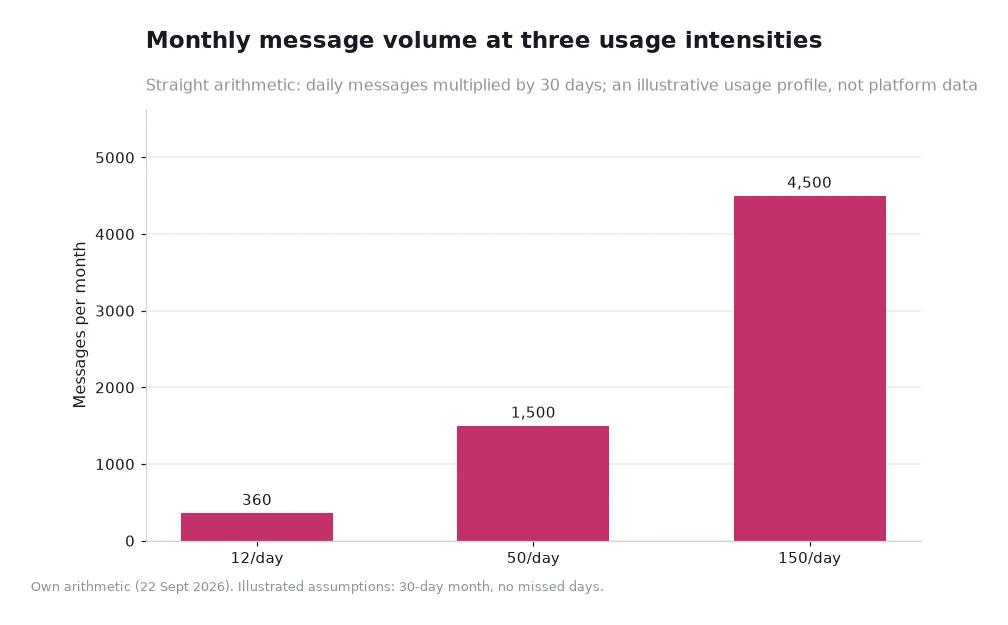
- Message volume turns the comparison practical — 12 a day is 360 a month, 50 a day is 1,500 and 150 a day is 4,500 — so a companion habit is a long-running thread, not a query.
Structure one: a catalogue instead of a prompt box
A general assistant gives you an empty field. Everything about the encounter depends on what you type, and nothing persists in the form of a discoverable entity. A companion platform inverts that: the starting point is a card, the card has a creator credit, a label set and a pair of counters, and the catalogue is organised so that browsing is a legitimate way to find something.
That changes the work. Instead of learning to write prompts, you learn to filter, compare and choose. The skills are different, and so is the failure mode: a general assistant fails when the instruction is unclear, whereas a companion platform fails when the card's setup is thin. That is the practical case for a Porn Chat AI service built around a curated catalogue: the setup already exists, so the reader's job is to choose well rather than to invent a character from nothing.
Structure two: a persona that persists
The second difference is continuity. Crushon describes characters that recall previous interactions, express emotions and adapt over time, and it describes responses as natural and adaptive to your personality and preferences. A purpose-built platform is organised around that promise, which is why the account page separates Characters, Memories and Creators.
A general assistant can be told to adopt a persona for a session, but the persona is not the product and there is nothing to preserve between visits. On a companion platform the persona is the product, and a reader's saved list is effectively a small shelf of ongoing conversations.
Structure three: the boundary is published
Filters such as Filtered, Unfiltered and 18+ are visible controls rather than hidden settings, and the platform states plainly that some limitations apply in accordance with its content and community guidelines. Alongside them sit a content removal policy, a complaints policy and a 2257 compliance statement explaining that the content is AI-generated text and depicts no real person.
That set of documents is what separates a specialised service from a general one in practical terms. Knowing what the content is, who to contact, and how a report is filed is information you can check before you invest any time in the platform.
| Criterion | Companion platform | General assistant | Why it matters |
|---|---|---|---|
| Starting point | A catalogue of character cards | An empty prompt field | Discovery happens before writing |
| Who writes the persona | Creators, credited on each card | Nobody; you instruct it | Consistency is a property of the card |
| Continuity | Recalled interactions and remembered preferences | Largely session-bound | Long threads read differently to short ones |
| Boundary | Filter tiers plus published guidelines and policies | Provider terms of use | You can check before committing |
| Content status | AI-generated text, no real person depicted | Mixed source material | Sets expectations for what you get |
Worked example: the volume question
Volume is where the structural difference becomes a time question. Multiply three daily habits by a 30-day month. At 12 messages a day: 12 × 30 = 360. At 50 a day: 50 × 30 = 1,500. At 150 a day: 150 × 30 = 4,500. The three readings are 360, 1,500 and 4,500, with the top reading 12.5 times the bottom.
Against a general assistant, 360 messages spread over a month is a set of unrelated questions. Against a companion platform, the same 360 messages are consecutive turns in a small number of conversations, and the value comes from the continuity between them. That is the whole argument for a purpose-built service: the same typing produces a thread with a history rather than a list of answers.
The daily figures are an illustrated assumption about a usage profile rather than platform data, and the month is assumed to have 30 days with no gaps. What the arithmetic clarifies is which product suits which habit — occasional factual queries need an assistant, whereas a habit that repeats daily accumulates into something a companion platform is designed to hold.
How to compare without naming names
Any comparison worth making can be run on five questions. Is there a catalogue with creator credits? Are the characters set up in writing or assembled by the reader each time? Is continuity described as part of the product or left to the session? Are the limits published with a report route attached? And is the content status stated plainly?
Answer those and the decision usually makes itself. If you want a persistent character with a written setup and a published boundary, the specialised route fits; if you want general answers, a general assistant fits better. From there, the practical next step is to look at the platform's own pages — Crushon's homepage, its chat page and the https://crushon.ai/ai-porn-chat overview — and check the same five answers against what is actually published rather than against a summary.
One further practical difference is where the effort lands. A general assistant asks the reader to write the brief, while a companion platform asks the reader to choose the character, and those two skills do not transfer between services.
Frequently asked questions
Is a specialised platform just a filtered general assistant?
No. The catalogue, the creator credits, the persistent personas and the published policies are separate design decisions, not a content filter applied to an existing assistant.
Does continuity mean the platform knows things beyond the conversation?
It means the service carries remembered preferences and earlier interactions for the account. Treat it as continuity inside your own use of the platform.
Which is better for a one-off question?
A general assistant. A companion platform is built for threads that continue, and the value of a character card comes from returning to it.
What should I check first on any platform of this kind?
The three published documents: what the content is, how a report is filed, and who to contact. All three should be linked from the site itself.
Choose by structure, not by label
Both kinds of service are useful, and they are useful for different things. If your habit is a recurring conversation with a character someone else wrote, look for a catalogue, persistent personas, published boundaries and a content statement that says plainly what you are reading. Compare on those four points, ignore the marketing adjectives, and the choice becomes an easy one to explain to yourself later.
Data and sources: platform structure, filter tiers and published policies on the Crushon site[1], plus listings on the trends page[2], read 22 Sept 2026. Message volumes are own arithmetic on an illustrated usage profile. Intended for an 18+ readership.